
How to Find Who Owns a Floyd County Property
The practical Floyd County route starts with a street address and ends with a deed check. Open the Commissioner of the Revenue’s real-estate portal. Accept the disclaimer, then locate the assessment record. The portal supplies owner, address, and parcel data. Take the Tax Map/Parcel ID it shows and find the same parcel in iGIS. Carry the owner name or instrument reference to the Circuit Court Clerk next. When a record names an LLC or other business, the Virginia State Corporation Commission’s Clerk’s Information System is the official entity lookup. That search identifies the company. It does not replace the deed.
- Locate the parcel from its address in the Commissioner’s assessment system.
- Record the exact Tax Map/Parcel ID and the owner name shown by the county.
- Search the Clerk’s grantor/grantee index and compare the latest deed’s grantee and legal description.
- If a business entity is named, check Virginia SCC records for its public entity filing and registered contact.
Where Floyd County Property Owner Information Comes From
Each Floyd County owner record serves a different purpose. The Commissioner maintains the assessment roll. The Circuit Court Clerk records deeds. iGIS works as a spatial reference. The Treasurer's account handles billing and payment. A map layer may display parcel information. But the county cautions that recorded deeds and plats control legal ownership and acreage. Keep the owner clue separate from the evidence of a recorded conveyance.
| Source | Owner Info It Gives | Access |
|---|---|---|
| Commissioner assessment roll | Owner and real-estate parcel data; exact card fields need live confirmation. | Official public portal with disclaimer acceptance. |
| Circuit Court Clerk | Grantee on recorded deed and legal description. | Computerized land index from 1970; earlier bound books. |
| Virginia SCC CIS | Public business-entity filings and UCC route. | Online Clerk’s Information System. |
| iGIS map | Spatial location and parcel reference, not title proof. | Public agreement screen and map terms. |
An owner of record may not occupy the property, receive the tax bill, or hold it under an individual name. A mailing address can differ from the situs address. A trust or entity may hold the recorded interest. Owner records alone never prove who lives at a location.
What a Floyd County “Who Owns This Property” Search Cannot Tell You
In public records, “who owns” has a narrow answer. It means whoever appears as the current owner on the assessment roll or as grantee on a recorded conveyance. Neither entry is a live occupancy list. A record search will not surface every unrecorded agreement, interpret a trust, or prove marketable title. Virginia also runs an Address Confidentiality Program that lets qualifying people use a designated address with mail forwarding. Respect those safety protections when using any record.
Lawful use. Use a Floyd County owner lookup for property research, title follow-up, and civic questions. Do not use an address or owner name to threaten, track, or harass anyone.
Start with the Floyd County Property Owner of Record
The Commissioner of the Revenue maintains Floyd County’s real-estate assessment roll and links a public Concise Systems portal. Every visitor accepts a disclaimer before entering. The portal states that the last general reassessment took effect January 1, 2025. It dates its public data to September 12, 2026. The owner field appears only inside the live portal. So confirm what it displays rather than assuming a mailing address or last-sale field will appear. The Commissioner’s office remains the assessment authority.
The official assessment portal notice shows its stated reassessment basis and update date.
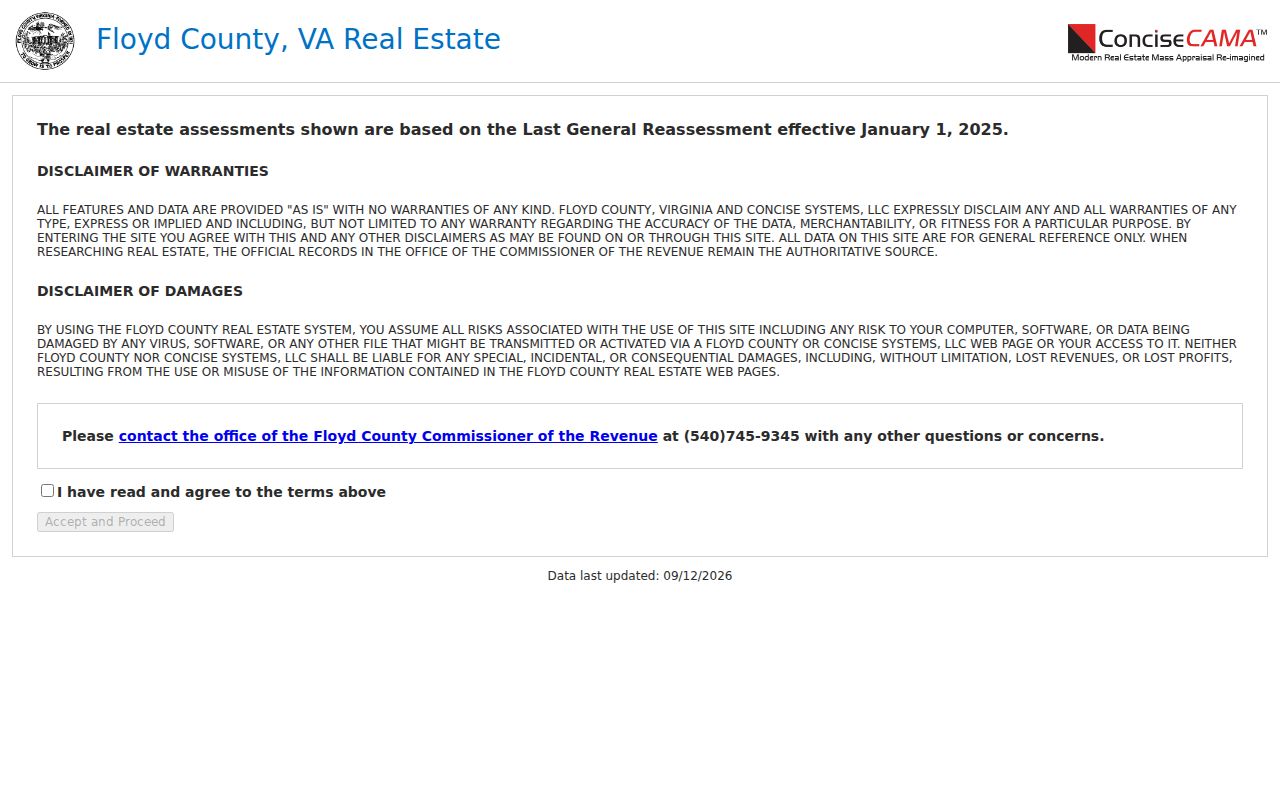
Keep the portal’s date in your notes. A current update marker does not override the annual owner timing rule.
Confirm Who Owns a Floyd County Property Against the Latest Deed
The Clerk’s computerized land-record index settles the question when the assessment owner may be stale. Coverage runs from 1970 to date. Search the owner as grantee to find the likely acquisition deed. Then check for a newer instrument conveying the same legal description. The index is organized by parties and instruments. It offers no simple street-address history. A reference from the assessment parcel cuts ambiguity. A recent deed can postdate the roll even when the portal carries a current update date.
For a new purchase, keep the deed date, recording date, parcel ID, and tax year together. The January 1 roll rule explains the mismatch. Ownership can look different across these sources. Neither record is internally inconsistent.
Who Owns a Floyd County Property Held by an Entity?
When the deed names a company, turn to the Virginia SCC Clerk’s Information System for the entity record and public filing details. The SCC also runs UCC and federal tax-lien searches. A business filing may identify an official contact. It does not necessarily name every person with an economic interest in the property. A trust name may require the recorded instrument or other lawful documentation. Do not expect a real-estate card to reveal beneficiaries. Match the entity name precisely. Compare its deed date with the parcel record.
Use the entity search as a cross-reference only. The Clerk’s instrument connects the entity to the land through the grantee and legal description.
Virginia SCC CIS is the official route for business-entity and UCC filings.
Before concluding anything, confirm the entity filing is active. Its name must match the recorded grantee exactly.
Separate a Floyd County Property Owner’s Mailing Address from Situs
Every parcel in Floyd County carries two addresses that often differ. The situs is simply where the land sits. The mailing address is where the tax bill goes. An owner of record can be a trust, a business, an estate, or a person living in another state. So the mailing address tells you where property mail should go, not where someone lives. Treat it as a contact clue for property matters only. Use lawful, relevant methods when you reach out. Do not republish private details just because they sat inside a public record.
Virginia runs an Address Confidentiality Program. It covers qualifying survivors of domestic violence, stalking, child abduction, sexual violence, or human trafficking. It works through a designated address with mail forwarding. That protection exists for good reason. An online owner result is never an invitation to find or approach a private person. When a record has been withheld or redacted, send an official request to the custodian instead.
Read an Owner Result as a Dated Record, Not a Live Directory
A Floyd County assessment roll is a dated snapshot, not a live directory of people. It refreshes around the tax year. The Commissioner processes transfers so the roll shows the owner on January 1. Record a deed after that cutoff. The new owner may still be missing from the roll for that tax year. A name in the deed index carries its own date and legal role. The two sources can disagree without either one being wrong.
A VADeed Alert notice adds one more layer. It confirms that a corresponding instrument was recorded, nothing more. It does not judge validity or occupancy. For a dependable answer, compare the newest assessment entry, the newest deed affecting the parcel, and the legal description side by side. If they still conflict, ask the Commissioner or Clerk to identify the relevant record rather than forcing the names into one tidy answer.