
Three Different Numbers in a Floyd County Property Value Search
Reading Floyd County property value records means keeping three numbers apart. The assessment comes from the Commissioner's roll. The market value is whatever a willing buyer and seller settle on. The consideration is the amount written into a recorded deed. Only that amount should ever be cited, labeled as recorded consideration rather than a current value. The Commissioner's portal anchors the assessment to the last general reassessment, effective January 1, 2025. The Treasurer, meanwhile, describes real-estate assessment as based on fair market value. The roll remains a public tax record. The portal does not display a live appraised-value field, a sale-history field, or a land-and-improvement split.
| Value | What It Is | Where |
|---|---|---|
| Assessed value | County roll value on the January 1, 2025 general reassessment basis. | Commissioner of the Revenue portal. |
| Market value | A sale-market concept, not a verified separate parcel-card field. | Independent appraisal or market evidence. |
| Recorded consideration | Amount shown in a recorded instrument, if the deed displays it. | Circuit Court Clerk deed image. |
| Land and improvement split | Exact portal display was not confirmed in static research. | Check the live assessment card or Commissioner. |
Know which number you are reading. A tax assessment, a deed's consideration, and a market appraisal answer different questions. The assessment drives the tax roll. The consideration on a deed records what a buyer paid at a past date. An appraisal estimates value for a sale today. The date attached to each figure matters just as much as the figure itself. No Floyd-specific assessment ratio or separate level-of-assessment figure is published, so treat any percentage you compute as your own arithmetic rather than an official ratio.
How to Look Up a Floyd County Assessed Property Value
Start at the Commissioner's official real-estate data portal. Read the disclaimer, then search by address or parcel information. The portal's live form accepts what it accepts. Field labels can change, so follow the ones on screen. Write down the Tax Map/Parcel ID, the assessment year, and the update date shown. Keep those three items together. For a sale figure, go to the Clerk instead. Find the most recent recorded deed for the parcel and read the instrument itself. Do not assume the assessment page carries a last-sale field. Note the instrument date alongside the amount. A consideration without its date tells you little.
- Open the Commissioner’s official assessment portal and accept its terms.
- Find the property using the current form and note the parcel identifier and assessment year.
- Confirm a recent transfer using the Clerk’s recorded deed and its stated consideration, if present.
- Contact the Commissioner if the field or valuation basis is unclear.
- Assessed value
- The value carried on the county’s assessment roll for taxation.
- Market value
- A price concept based on a potential exchange, not a guaranteed assessment field.
- Recorded consideration
- The amount associated with a deed when the recorded instrument states one.
What a Floyd County Assessed Value Cannot Tell You
An assessed value is not a current offer. It is not an independent appraisal. It is not a promise of what a property will sell for. The roll's public update date has its own limits. It does not prove a recent transfer or improvement has already moved the number. Some buildings are assessed sooner. New substantially complete buildings are assessed in that year. Buildings fit for occupancy before November 1 are too. Other new construction gets picked up annually, subject to the general-reassessment-year rule the Commissioner describes. Ask the office directly how a specific improvement was treated.
Value vs price. A Floyd County assessed value is used in the county tax record and is not a sale appraisal. For a transaction-specific valuation, use a qualified independent appraiser.
Floyd County Property Value: The 2025 Reassessment Is the Roll Anchor
Floyd County's last general reassessment took effect January 1, 2025. The date comes from the county assessment site. The Commissioner notes that the Board of Supervisors sets the date for a general reassessment. The portal also lists a public-data update of September 12, 2026. These two dates answer different questions. One marks the reassessment effective date. The other marks the online data update. Neither says a particular property sold on either day. Comparing Floyd County property value records works best when you note both dates. Note the assessment year and the latest portal date shown. The county's assessment disclaimer lays out the reassessment basis and the update information.
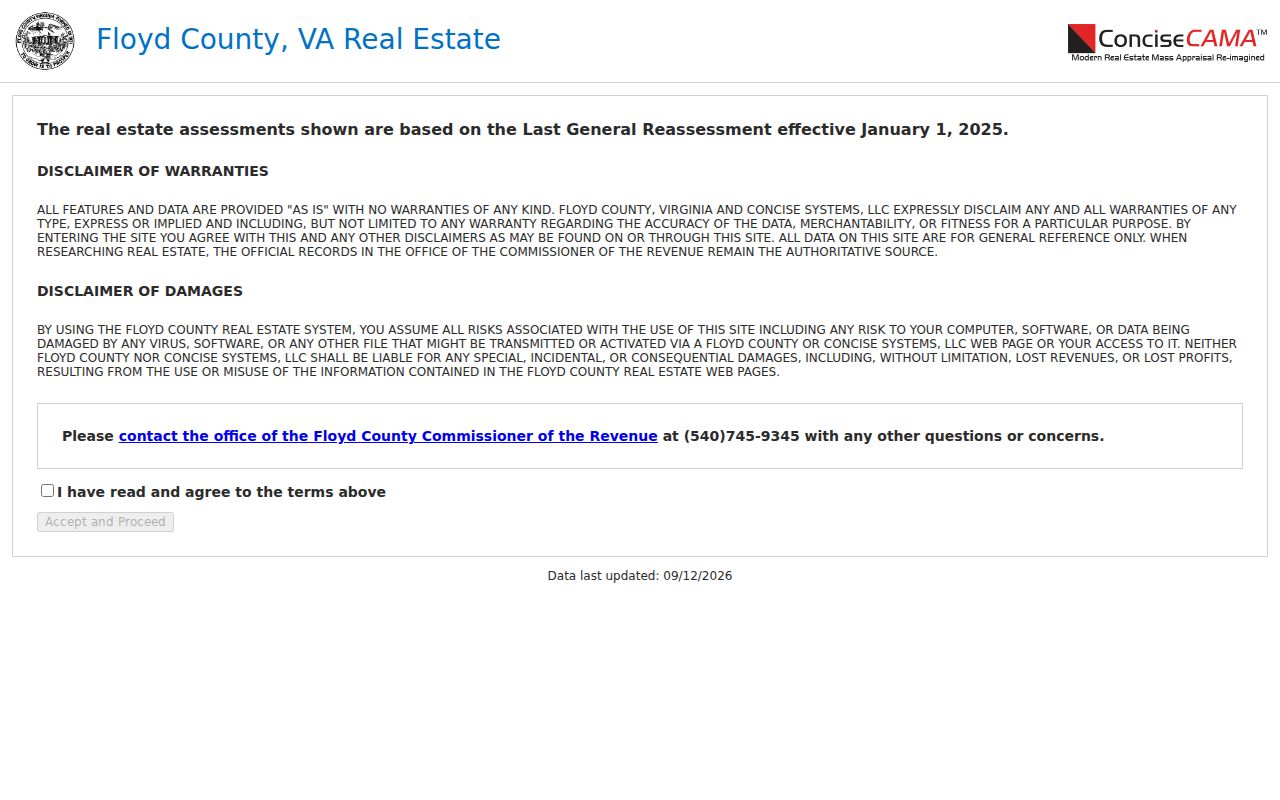
The Commissioner's assessment record still governs, so treat the portal as reference data only.
Floyd County Property Value and Sale Records Carry Different Dates
Timing explains most confusion in Floyd County property records. The Commissioner records real-estate transfers. So the tax roll reflects the owner of record on January 1 of the tax year. A deed recorded later does not change that owner for the current year. Consider the deed date. Add the sale date and the tax year. The portal's update date is a fourth. These four dates are separate things, and each answers a different question.
The same caution applies to value. A recent transfer may state its consideration in the instrument, so read the deed itself. An old recorded amount is never the current market value. Property records carry dates, and each date answers a different question.
When the assessor's name and the deed records disagree, timing is usually the reason. Ask the Commissioner how the parcel is carried for the current tax year. Only then decide the property value record is stale.
Floyd County Assessed Property Value Has Its Own Construction Timing
Floyd County property records follow a construction cutoff of their own. A new building substantially complete or fit for use before November 1 gets assessed that year. Other new construction is picked up annually. A general reassessment year changes the rule. New Class Four industrial or commercial buildings are the exception.
This matters when an improvement changes. But the assessment record has not caught up with a permit or construction event. The published sources give no parcel-specific adjustment formula. So ask the Commissioner about a particular project.
Permits and inspection histories document approvals and work. They do not set the assessed value. Keep those record types separate when you review a house history.
Separate Floyd County Property Value from the Tax Bill
The Commissioner of the Revenue keeps the assessment roll. The Treasurer handles the billing side, sending out tax bills and collecting payments. A property value is just one input to a tax account, not the amount owed. Payment timing, installment status, penalties, and interest all live in the Treasurer's records. The county sets June and December due dates. For the current balance on a parcel, ask the Treasurer instead of reading an assessed value as a bill. The property tax page covers those payment records separately.
Keep your comparison apples to apples. Match the parcel number, the assessment year, and the reassessment basis first. Only then draw any conclusion from two value cards. For a payment question, match the account number and installment year instead. The same land can show up in both offices, but the numbers serve different purposes.
Floyd County Property Value Questions Go to the Commissioner
When an online value looks inconsistent with a parcel description or an improvement, take it to the Commissioner of the Revenue. The office sits at 201 East Main Street, Suite 3, Floyd, Virginia 24091, with mail to PO Box 777, and answers the phone at 540-745-9345. Published hours are 8:30 a.m. to 4:30 p.m. Give staff the Tax Map/Parcel ID, the year displayed, and where your comparison figure came from. Ask them to sort out whether the issue needs a data correction, an assessment review, or a formal appeal. Request the appeal procedure and deadline right away, since the office publishes the current form and cut-off dates rather than leaving them to assumption.
The county portal describes its online data as reference material. The Commissioner's office is the authoritative source. No public screen can interpret a value difference for you, so a short call or visit settles what a number on a website cannot.
Compare Floyd County Property Values Without Inventing a Trend
The county publishes no Town-only value trend table or time series. Resist the urge to call one neighborhood rising or falling. Do not judge it from a few current cards. A defensible comparison rests on matched parcels, and it requires the same assessment years plus a method you can point to. Split land and improvement values only when the live assessment record actually shows that breakdown. For a sale comparison, pull the consideration stated in the recorded deed. Name the transfer date. Do not treat one sale as a current appraisal or a full market sample.
A county-wide average deserves the same caution. Two parcel values cannot establish a local trend on their own. That takes a published dataset, and a stated calculation method.